I must apologize for my long absence. The stressful situation to which I've alluded in previous posts continues, and it seems that more often than not lately, I arrive home with no energy left to draft a post worth reading.
I'd be lying if I said the same stress hasn't affected my training; it has. More than once, I've given up my weeknight training plans in favor of a few hours' escape through cooking or a book. Horse training takes a great deal of emotional intensity, and I often feel I have little left to give.
And yet, I have kept on. It's well past time I updated you on my 2010 plans for the equine residents of In the Night Farm. Mind you, I've learned my lesson about setting hard and fast goals when it comes to training and endurance conditioning. Something is bound to go wrong, and having expectations too high only makes the fall too painful.
These, then, are ideals. I'll work toward them and get as far as I can, and take the pitfalls in stride. Stay tuned for updates on each of the following horses:
Inara -- As part of her purchase price, Inara is to go to her new owner with basic groundwork complete. She'll catch, lead, lunge, pick up feet, deworm, and trailer load.
Alternating Current (aka Acey) -- It's time to start this fiery, little mare under saddle. It would be fantastic to have her ready for her first LD by the end of the season, but I'll settle for getting well into a foundation of long, slow distance work in preparation for next year.
Ripple Effect -- Can you believe she's four this year? Yes, it's time to start her under saddle, too. A significant part of the project will be getting her comfortable with leaving the other horses and facing the great, wide world.
Sandstorm -- You haven't seen enough of this fantastic mare. The tallest Barb in my herd, she's an astonishing mover with a sweet but cautious personality and potential I'm just beginning to tap. I'd like to finish gentling her (she's another that arrived at In the Night Farm completely untouched) and get plenty of groundwork done so I can start riding her next year.
Consolation -- Endurance, of course! We had a setback in mid-June that has taken us out of conditioning for a while (details in an upcoming post), but it's about time to hit the trail again. Hooray!
Crackerjack -- See "Ripple Effect." These half-siblings were born just a few days apart, but CJ isn't quite as physically mature as his lookalike sister. Still, it won't hurt to proceed with his groundwork as soon as I'm done with Inara to free up a time slot. Maybe, by the end of the season, it'll be time to step aboard.
I must say, it's nice to come in after a long day in the round corral, pour a tall glass of iced tea, and look out over so many sweat-stained equine backs. I know just how they feel. We're working hard, the ponies and I. We'll get there.
_________________________
By the way, I'm still encountering spam problems despite having enabled the word verification feature for comments. Sadly, this has forced me to take the next step -- comment moderation. So, you'll notice a delay between commenting and seeing your comment posted. I'll try going back to just word verification after a while, when the Chinese-character blighter decides to give it a rest.
_________________________________________________________
Subscribe to The Barb Wire
Showing posts with label Ripple Effect. Show all posts
Showing posts with label Ripple Effect. Show all posts
Sunday, July 11, 2010


Sunday, November 1, 2009
Shot in the Dark: Wisdom

He who seeks Wisdom by looking to the wise
may count himself among them.
_________________________________________________________may count himself among them.
Want to read more posts like this one? Subscribe to The Barb Wire
Wednesday, December 24, 2008
You Better Watch Out...
I spent a few minutes this morning preparing the horses for Santa's arrival. Acey was a bit suspicious...

...but Ripple took it in stride.

I think I'll send her out to greet the reindeer. Santa might be inspired to leave extra presents for the ponies!
 _________________________________________________________
Want to read more posts like this one? We deliver!

...but Ripple took it in stride.

I think I'll send her out to greet the reindeer. Santa might be inspired to leave extra presents for the ponies!
 _________________________________________________________
Want to read more posts like this one? We deliver!
Saturday, August 9, 2008
The Measure of a Horse: Dennis Lane Equine Back Profiling System, Take One
Meet Ripple Effect.
 This 2006 Jack Slade granddaughter by Jack's Legacy out of Alternating Current (aka Acey) is 25 months old, so she's a couple years away from needing her first Stonewall saddle. All the same, I wanted data on her back so I can observe how it changes over time; also, the information may be valuable to those who are compiling details about how Spanish Colonial horses' conformation compares to that of other breeds.

Ripple stood nicely for measuring and photos. I'm new to the Dennis Lane system, so I appreciated her patience while I drew chalk lines on her back, experimented with notched cards, re-read directions, mopped my forehead, started again.
Here are the results:
 A: S4 (This means that if I were to order a custom saddle for Ripple today, the tree would, at the withers, match the narrowest profile in the Dennis Lane system.)
B: S7 (Again, a fairly narrow measurement at the lowest point of Ripple's back, the base of her withers. However, after talking with Fenaroli of Stonewall Saddle Company this evening about how to use the profiling cards properly, I wonder if this ought to be an even narrower S6. I'll have to double-check.)
C: S5 (This, too, is a narrow measurement near the 13th and 14th vertebrae, where the back of the saddle would rest.)
R: Flatter than R6 (The Dennis Lane system measures "rock" with a set of cards designed to determine the shape of the sides of the horse's back, horizontally, where the saddle's bars will rest. As a maturing horse, Ripple's back is flatter than the card with the least "rock."
S: 8 inches. (This is the distance between the lowest point of Ripple's back and the rearmost edge of her scapula.)
If the above makes no sense to you, but you're curious, visit the Dennis Lane website and scan the instructions. Or, just stay tuned to The Barb Wire blog for more profiling photos and results.
Sculptor Lynn Fraley of Laf'n Bear Studio will return to In the Night Farm later this morning to take more photos and video of the Barbs. A dedicated student of equine anatomy, she'll also join me in profiling at least one Barb's back.
By the way, I'm considering making Ripple Effect available for sale to the right person. If you're interested in this sweet filly, feel free to contact me via the email address in the sidebar at right.


 This 2006 Jack Slade granddaughter by Jack's Legacy out of Alternating Current (aka Acey) is 25 months old, so she's a couple years away from needing her first Stonewall saddle. All the same, I wanted data on her back so I can observe how it changes over time; also, the information may be valuable to those who are compiling details about how Spanish Colonial horses' conformation compares to that of other breeds.
Ripple stood nicely for measuring and photos. I'm new to the Dennis Lane system, so I appreciated her patience while I drew chalk lines on her back, experimented with notched cards, re-read directions, mopped my forehead, started again.
Here are the results:
 A: S4 (This means that if I were to order a custom saddle for Ripple today, the tree would, at the withers, match the narrowest profile in the Dennis Lane system.)
B: S7 (Again, a fairly narrow measurement at the lowest point of Ripple's back, the base of her withers. However, after talking with Fenaroli of Stonewall Saddle Company this evening about how to use the profiling cards properly, I wonder if this ought to be an even narrower S6. I'll have to double-check.)
C: S5 (This, too, is a narrow measurement near the 13th and 14th vertebrae, where the back of the saddle would rest.)
R: Flatter than R6 (The Dennis Lane system measures "rock" with a set of cards designed to determine the shape of the sides of the horse's back, horizontally, where the saddle's bars will rest. As a maturing horse, Ripple's back is flatter than the card with the least "rock."
S: 8 inches. (This is the distance between the lowest point of Ripple's back and the rearmost edge of her scapula.)
If the above makes no sense to you, but you're curious, visit the Dennis Lane website and scan the instructions. Or, just stay tuned to The Barb Wire blog for more profiling photos and results.
Sculptor Lynn Fraley of Laf'n Bear Studio will return to In the Night Farm later this morning to take more photos and video of the Barbs. A dedicated student of equine anatomy, she'll also join me in profiling at least one Barb's back.
By the way, I'm considering making Ripple Effect available for sale to the right person. If you're interested in this sweet filly, feel free to contact me via the email address in the sidebar at right.

_____________________________________
Related Posts
It's Here!: Dennis Lane Equine Back Profiling System
Dennis Lane Equine Back Profiling System, Take Two
_____________________________________
Want to read more posts like this one? We deliver!
Tuesday, March 25, 2008
Enough is Enough: Communicating with Horses
The familiar Biblical admonishment, "Fathers, do not exasperate your children," often comes to mind while I train. The text might as easily advise, "Trainers, do not exasperate your horses."
Many trainers emphasize the importance of extensive repetition to equine learning. In his books, John Lyons recommends counting 50 or more repetitions of a single exercise, such as the "go forward" cue, on the theory that a horse won't fully understand what he's doing right without that much practice.
I respect many things about John Lyons (not least, his marketing ability) but endless repetition is a point on which we disagree. If I tapped Consolation's hip an d asked her to go forward, then stop, then go forward, then stop 50 times, she'd kick me from here to Rhode Island... and I'd deserve it.
Note: That's our Barb filly Ripple Effect in the photos, during her first lunging lesson in November 2007.
Perhaps breed is a key factor in the debate. Lyons' longtime star performer was an Appaloosa called Zip. Lyons is almost always pictured aboard Quarter Horses or breeds of similar type, as are other riders featured in his books and DVDs. Quarter Horse types, on the whole, come standard with a different kind of mind than Barbs, Arabians, and other hot bloods.
Quick history lesson: Most of the horses brought to the New World beginning with Columbus' second voyage in the late 1400's were small, hardy, hot blooded Spanish stock. For years, many colonists and American Indian tribes bred superior horses of a type commonly referred to today as "Spanish Colonial." It was astride some of our Barbs' ancestors that Chief Joseph's Nez Perce tribe outran the U.S. Army for nearly 2,000 miles in 1877.
Sadly, the Army failed to recognize the quality of these flashy-coated but small horses. Upon Chief Joseph's surrender, most of the Nez Perce's stallions, like those of many other tribes, were gelded or shot. Draft and thoroughbred stallions were turned out in their place in hopes of improving upon the tough, little mares.
While the Spanish Colonial type still reigns in South America, we North Americans have become unaccustomed to them. My neighbor with the bay mare wasn't the first to comment, albiet in a non-disparaging tone, that my Barbs "don't look like normal horses."
Indeed, today's Quarter Horses and their colored cousins, the Appaloosas and Paints, are heavily influenced by the extensive cross-breedings that nearly wiped out the Spanish Colonial type in North America. These breeds include a number of fine individuals, but on the whole they reflect the cold blood of their draft ancestors not only in their bulky, fast-twitch muscle fibres, but also in their relatively lethargic mentality.
Many equestrians, like Lyons, prefer Quarter Horse types for their muscular physique and quiet demeanor. There's something to be said for a horse that will tolerate a great deal of abuse, whether intentionally in the form of "cowboying" or unwittingly by careless or novice riders. With this advantage, however, comes thicker skin -- figuratively and sometimes literally -- that requires more repetition before a lesson breaks through.
 Our Barbs, however, learn so quickly that one or two repetitions is often sufficient. My usual training tactic is to make a request, reward attempts at the right answer, repeat the behavior several times to be sure the horse understands, then move on to something else and review the lesson later. Lingering too long on a single task results in a bored and frustrated horse. I can almost hear such an animal thinking, "I've got it, lady. Lay off."
You know the familiar advice: Always finish on a good note. Too often, this is applied as follows:
1) Trainer frustrates horse by repeating the lesson too many times after horse "gets it"
2) Horse reacts by seeming to forget or rebel against the lesson he just learned
3) Trainer, also frustrated, continues drilling horse
4) Horse complies, but shoddily and with a poor attitude
5) Trainer quits, believing herself to have ended on a "good note"

I've done it.
Haven't you?
Blessed was the day I learned to stop just after the epiphany, when both horse and trainer are triumphant.
We did it, partner! We're brilliant together! Let's do it again tomorrow!
Many trainers emphasize the importance of extensive repetition to equine learning. In his books, John Lyons recommends counting 50 or more repetitions of a single exercise, such as the "go forward" cue, on the theory that a horse won't fully understand what he's doing right without that much practice.
I respect many things about John Lyons (not least, his marketing ability) but endless repetition is a point on which we disagree. If I tapped Consolation's hip an
 d asked her to go forward, then stop, then go forward, then stop 50 times, she'd kick me from here to Rhode Island... and I'd deserve it.
Note: That's our Barb filly Ripple Effect in the photos, during her first lunging lesson in November 2007.
Perhaps breed is a key factor in the debate. Lyons' longtime star performer was an Appaloosa called Zip. Lyons is almost always pictured aboard Quarter Horses or breeds of similar type, as are other riders featured in his books and DVDs. Quarter Horse types, on the whole, come standard with a different kind of mind than Barbs, Arabians, and other hot bloods.
Quick history lesson: Most of the horses brought to the New World beginning with Columbus' second voyage in the late 1400's were small, hardy, hot blooded Spanish stock. For years, many colonists and American Indian tribes bred superior horses of a type commonly referred to today as "Spanish Colonial." It was astride some of our Barbs' ancestors that Chief Joseph's Nez Perce tribe outran the U.S. Army for nearly 2,000 miles in 1877.
Sadly, the Army failed to recognize the quality of these flashy-coated but small horses. Upon Chief Joseph's surrender, most of the Nez Perce's stallions, like those of many other tribes, were gelded or shot. Draft and thoroughbred stallions were turned out in their place in hopes of improving upon the tough, little mares.
While the Spanish Colonial type still reigns in South America, we North Americans have become unaccustomed to them. My neighbor with the bay mare wasn't the first to comment, albiet in a non-disparaging tone, that my Barbs "don't look like normal horses."
Indeed, today's Quarter Horses and their colored cousins, the Appaloosas and Paints, are heavily influenced by the extensive cross-breedings that nearly wiped out the Spanish Colonial type in North America. These breeds include a number of fine individuals, but on the whole they reflect the cold blood of their draft ancestors not only in their bulky, fast-twitch muscle fibres, but also in their relatively lethargic mentality.
Many equestrians, like Lyons, prefer Quarter Horse types for their muscular physique and quiet demeanor. There's something to be said for a horse that will tolerate a great deal of abuse, whether intentionally in the form of "cowboying" or unwittingly by careless or novice riders. With this advantage, however, comes thicker skin -- figuratively and sometimes literally -- that requires more repetition before a lesson breaks through.
 Our Barbs, however, learn so quickly that one or two repetitions is often sufficient. My usual training tactic is to make a request, reward attempts at the right answer, repeat the behavior several times to be sure the horse understands, then move on to something else and review the lesson later. Lingering too long on a single task results in a bored and frustrated horse. I can almost hear such an animal thinking, "I've got it, lady. Lay off."
You know the familiar advice: Always finish on a good note. Too often, this is applied as follows:
1) Trainer frustrates horse by repeating the lesson too many times after horse "gets it"
2) Horse reacts by seeming to forget or rebel against the lesson he just learned
3) Trainer, also frustrated, continues drilling horse
4) Horse complies, but shoddily and with a poor attitude
5) Trainer quits, believing herself to have ended on a "good note"

I've done it.
Haven't you?
Blessed was the day I learned to stop just after the epiphany, when both horse and trainer are triumphant.
We did it, partner! We're brilliant together! Let's do it again tomorrow!
Friday, March 21, 2008
The Stars of Our Show: Barb Horses at In the Night Farm
A fellow blogger at Global Horse Culture recently expressed the hope that I would share more about how we chose our Barbs. This, I suspect, is a two part request: First and most important is the question of why we prefer the International Barb Horse Registry (IBHR) horses as preserved by Robert Painter of Quien Sabe Ranch. Second, what drove our selection of the seven individuals that comprise our little breeding program here at In the Night Farm?
Because it is Friday and I remain in a funk about my sprained ankle, I'll address the simpler question first -- why did we choose these particular Barbs?
Selecting horses from the Quien Sabe herd isn't as easy as looking down a list of available horses, marking the most interesting on the basis of bloodlines or price or what have you, then taking those animals for a test drive. You see, very few horses on the ranch are gentled at all, let alone halter broke or started under saddle. The herd, seperated in various ways by age and/or gender, runs essentially wild on over 400 acres near Midvale, Idaho. Extensive wandering on diverse footing wears their hooves beautifully, strengthens muscle and bone, and sharpens their wits.
Visitors may walk among the horses, but few members of the herd allow themselves to be touched. Those that do -- often, the boldest two-year-olds -- extend elegent necks to flutter nostrils against outstretched fingertips before retreating, all snort and prance, among their fellows.
Travis and I had the advantage of spending a great deal of time at the ranch, observing the herd that numbered around 200 head, absorbing tales of their ancestors, and watching the young horses mature. When we moved back to the Treasure Valley, we brought with us five Barbs.


 Alternating Current, better known as Acey, is a 2003, bay rabicano mare by Marawooti out of Chiripa. I haven't measured her recently, but I'd venture a guess that as our smallest Barb, she's topped out at 13 hands. Fine-featured and adorable under a great puff of forelock (see the photo at the bottom of this post), Acey stood out among the other Quien Sabe fillies for her alertness, petite but sturdy and balanced conformation, and an alluring, undefinable charm. Friendly and sensible, she's a pleasure to train and should be well started under saddle by Fall 2008.
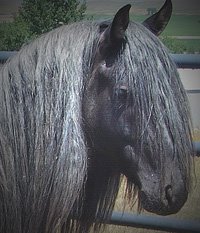
 Sandstorm, the lovely grulla featured in our blog header, is a 2003 mare by IBHR foundation stallion Lancelot out of Sands of Time. Very like her sire, Sandstorm is quite cautious, though not exactly "spooky," and eager to comply once assured that she won't be harmed. I'm still in the early phases of gentling Sandstorm, but I suspect that once I have her trust, she'll come along very quickly indeed. I look forward to the day I can sit aboard the sailboat-smooth and lightening-fast extended trot that first attracted my attention at the ranch.
When Consolation and Acey came to In the Night Farm, both were in foal to Jack's Legacy of Quien Sabe Ranch. Anyone familiar with Spanish Mustangs will recognize in Legacy the trademark color and mane of his sire, Jack Slade. (Note: Although the Spanish Mustang Registry (SMR) includes a number of horses we believe to be Barbs, an examination of SMR stock reveals a broader spectrum of types than is included in the IBHR. In the Night Farm's Barbs are IBHR registered and although they share bloodlines with some SMR horses, our horses should not be considered Spanish Mustangs.)
 CJ is especially eye-catching, and it may just break my heart to have him gelded this spring. However, I am determined to enjoy our Barbs as well as preserve and promote them, and In the Night Farm is fortunate to have two very nice stallions already. Outstanding in physique and personality, CJ is poised for a career as one of the finest geldings on the endurance trails.

Ripple Effect retains the lovely Marawooti head of her grandsire. Indeed, she looks so much like her dam that I often mistake them for one another when feeding before dawn. Inquisitive, bold as brass, generous, sweet-natured, and honest, Ripple ought to make a high quality riding horse, as well as a source of the Jack Slade line in our herd.
And there you have it, a summary of our precious herd. In a later post, I'll address the reasons for In the Night Farm's commitement to promotion and preservation of the IBHR Barbs.
Because it is Friday and I remain in a funk about my sprained ankle, I'll address the simpler question first -- why did we choose these particular Barbs?
Selecting horses from the Quien Sabe herd isn't as easy as looking down a list of available horses, marking the most interesting on the basis of bloodlines or price or what have you, then taking those animals for a test drive. You see, very few horses on the ranch are gentled at all, let alone halter broke or started under saddle. The herd, seperated in various ways by age and/or gender, runs essentially wild on over 400 acres near Midvale, Idaho. Extensive wandering on diverse footing wears their hooves beautifully, strengthens muscle and bone, and sharpens their wits.
Visitors may walk among the horses, but few members of the herd allow themselves to be touched. Those that do -- often, the boldest two-year-olds -- extend elegent necks to flutter nostrils against outstretched fingertips before retreating, all snort and prance, among their fellows.
Travis and I had the advantage of spending a great deal of time at the ranch, observing the herd that numbered around 200 head, absorbing tales of their ancestors, and watching the young horses mature. When we moved back to the Treasure Valley, we brought with us five Barbs.
Insider, our 2000 Barb stallion by Idaho Night Hawk out of Chispa, was the first to be chosen. If you ever meet him in person, you'll understand my immediate attraction to this horse. He is lovely in every way -- at 13.3 hands, he's well-muscled and strong -boned, kind-eyed, and possessed of an enviable double mane. Dr. Phillip Sponen- berg, respected livestock genetics expert and author of Equine Color Genetics, met Insider and both his parents in 2006. At that time, he informed me that Insider is most likely a "purple roan," which is to say, a mahogany bay roan. In winter, Insider's coat turns a rather muddy shade of violet-brown, but in summer he is all shine and glory, speckled with dark corns (irregular spots that increase in number with age), and glinting with a coppery sheen typically associated with Akhal Tekes' metallic coats. But it was Insider's personality that attracted me most of all...perhaps because he and I are so much alike: restless, inquisitive, stubborn, determined, and formidable when crossed. And, we both appreciate a good meal.
 -boned, kind-eyed, and possessed of an enviable double mane. Dr. Phillip Sponen- berg, respected livestock genetics expert and author of Equine Color Genetics, met Insider and both his parents in 2006. At that time, he informed me that Insider is most likely a "purple roan," which is to say, a mahogany bay roan. In winter, Insider's coat turns a rather muddy shade of violet-brown, but in summer he is all shine and glory, speckled with dark corns (irregular spots that increase in number with age), and glinting with a coppery sheen typically associated with Akhal Tekes' metallic coats. But it was Insider's personality that attracted me most of all...perhaps because he and I are so much alike: restless, inquisitive, stubborn, determined, and formidable when crossed. And, we both appreciate a good meal.
Tuetano is our other stallion, born in 2002 by Fuego out of Quieta. A bay roan like most of Fuego's get, Tano stands about 14.2 and has unusually expressive eyes. At Quien Sabe, he stood out among his fellow three-year-olds as a tough and stylish colt. Upon arrival at In the Night Farm in 2006, Tano was still on the gangly side, but he has grown into a beautifully conformed representative of the Barbs. We selected him from a short list of available Quien Sabe colts, not only on his own potential, but also on the basis of his sire's exceptional quality and obvious prepotency (for more than just color). In personality, Tano is both sweeter and shier than Insider, suspicious of new activity but endlessly curious and eager to please.
Consolation, our 2002 mare by IBHR foundation stallion Arivaca out of Dove, has already been introduced in this post. She came to us as part of a barter, and I confess she would not have been my first choice from the Quien Sabe fillies her age. I'm pleased to report, however, that despite my intial misgivings, Consolation has blossomed into what is arguably our finest mare and a stellar example of the breed. Her training continues to progress and I'm looking forward to her first Limited Distance race in 2008.
 Alternating Current, better known as Acey, is a 2003, bay rabicano mare by Marawooti out of Chiripa. I haven't measured her recently, but I'd venture a guess that as our smallest Barb, she's topped out at 13 hands. Fine-featured and adorable under a great puff of forelock (see the photo at the bottom of this post), Acey stood out among the other Quien Sabe fillies for her alertness, petite but sturdy and balanced conformation, and an alluring, undefinable charm. Friendly and sensible, she's a pleasure to train and should be well started under saddle by Fall 2008.
 Sandstorm, the lovely grulla featured in our blog header, is a 2003 mare by IBHR foundation stallion Lancelot out of Sands of Time. Very like her sire, Sandstorm is quite cautious, though not exactly "spooky," and eager to comply once assured that she won't be harmed. I'm still in the early phases of gentling Sandstorm, but I suspect that once I have her trust, she'll come along very quickly indeed. I look forward to the day I can sit aboard the sailboat-smooth and lightening-fast extended trot that first attracted my attention at the ranch.
When Consolation and Acey came to In the Night Farm, both were in foal to Jack's Legacy of Quien Sabe Ranch. Anyone familiar with Spanish Mustangs will recognize in Legacy the trademark color and mane of his sire, Jack Slade. (Note: Although the Spanish Mustang Registry (SMR) includes a number of horses we believe to be Barbs, an examination of SMR stock reveals a broader spectrum of types than is included in the IBHR. In the Night Farm's Barbs are IBHR registered and although they share bloodlines with some SMR horses, our horses should not be considered Spanish Mustangs.)
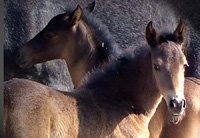
In July 2006, Crackerjack, aka "CJ," (colt, Jack's Legacy x Consolation) and Ripple Effect (filly, Jack's Legacy x Alternating Current) were born just three days apart. Beneath the awkwardness of youth, both show every sign of developing into lovely horses indeed.
CJ is especially eye-catching, and it may just break my heart to have him gelded this spring. However, I am determined to enjoy our Barbs as well as preserve and promote them, and In the Night Farm is fortunate to have two very nice stallions already. Outstanding in physique and personality, CJ is poised for a career as one of the finest geldings on the endurance trails.
Ripple Effect retains the lovely Marawooti head of her grandsire. Indeed, she looks so much like her dam that I often mistake them for one another when feeding before dawn. Inquisitive, bold as brass, generous, sweet-natured, and honest, Ripple ought to make a high quality riding horse, as well as a source of the Jack Slade line in our herd.
And there you have it, a summary of our precious herd. In a later post, I'll address the reasons for In the Night Farm's commitement to promotion and preservation of the IBHR Barbs.
Subscribe to:
Posts (Atom)